 Tablux
Database client
PostgreSQL client for Mac, iPhone and iPad
Tablux is a Postgres client and GUI for the Mac that also runs on iPhone and iPad, with one App Store purchase for all three. Connect with host, port, database, user and password, directly or through an SSH tunnel. Browse schemas, tables and keys, write SQL with highlighting and completion, and see table sizes and problems such as foreign keys with no index as soon as you connect.
What connecting needs
| Field | What to enter |
|---|---|
| Host, Port | The server name and port, 5432 by default |
| Database | The database to open; empty means postgres |
| User, Password | Your login. The password goes into the system keychain on this device only |
| Use SSL / TLS | On by default. It encrypts the connection; it does not verify the server’s certificate |
| SSH tunnel | Optional: SSH host, port, user, and a password or private key. The host key is pinned the first time you trust it |
| Environment, Read-only | A Development, Staging or Production tag, and a switch that makes the session read-only on the server |
Test shows the server version before you save. Tablux connects straight from your device, or through your SSH server.
Supabase: copy the pooler host from the project’s Connect dialog and use session mode on port 5432, with the user written as postgres.<project-ref> (or <role>.<project-ref> for your own role). Avoid transaction mode on port 6543 for Tablux: Supabase’s docs note that session-level state is lost between transactions there, and Tablux’s read-only switch is a session setting.
Amazon RDS: use the instance endpoint and port 5432, and keep SSL on. RDS for PostgreSQL 15 and later set rds.force_ssl to 1 by default, so connections without SSL are rejected. For an instance in a private subnet, turn on the SSH tunnel and go through a bastion host in the VPC (see SSH tunnels).
No server handy? Connect to the hosted read-only demo database.
Writing SQL on a Mac, iPhone or iPad
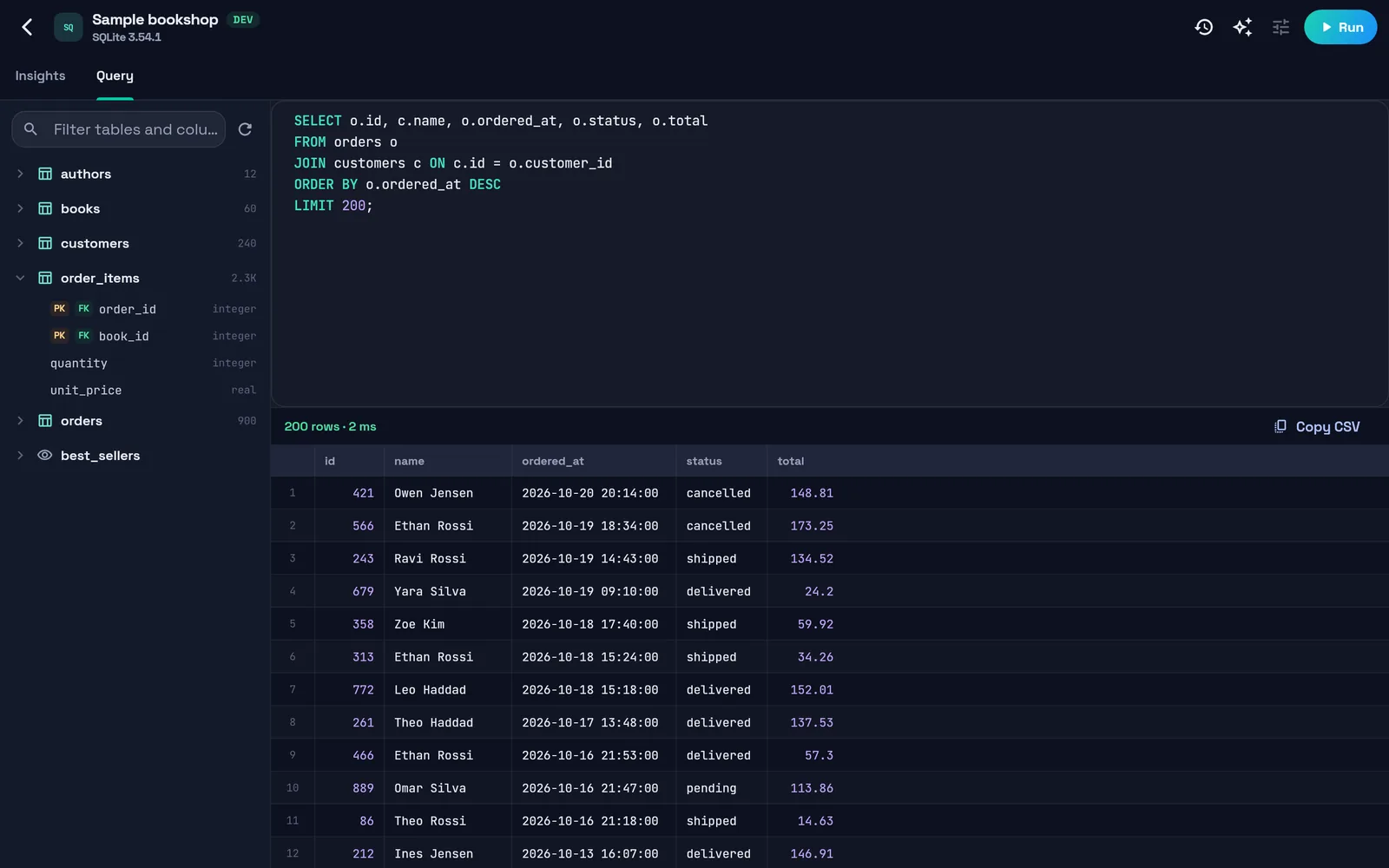
On a Mac or a wide iPad window, schema, editor and results sit side by side. ⌘+Return or F5 runs the selection, or everything when nothing is selected. On iPhone a key bar above the keyboard puts SELECT, FROM, WHERE, JOIN, quotes and brackets one tap away, and turns into completions of your own table and column names while you type. Smart quotes and auto-correct stay out of the editor.
Statements run in order on one connection, so a BEGIN in one run and a COMMIT in the next belong to the same transaction. Queries worth keeping in history:
-- The 20 largest tables, with live row estimates
SELECT schemaname, relname,
       pg_size_pretty(pg_total_relation_size(relid)) AS total_size,
       n_live_tup
FROM pg_stat_user_tables
ORDER BY pg_total_relation_size(relid) DESC
LIMIT 20;
-- What is running right now, longest first
SELECT pid, now() - query_start AS running_for, state, left(query, 80) AS query
FROM pg_stat_activity
WHERE state <> 'idle'
ORDER BY running_for DESC;-- Sessions waiting on someone else's lock
SELECT pid, pg_blocking_pids(pid) AS blocked_by, left(query, 60) AS query
FROM pg_stat_activity
WHERE cardinality(pg_blocking_pids(pid)) > 0;The AI assistant can write, explain or fix a query from your schema. It sees table and column names, never rows, and the SQL lands in the editor for you to run.
What the schema view shows
Every non-system schema, with its tables and views. Each table shows its columns with type and nullability, the primary key, and where each foreign key points (orders.customer_id → customers.id), plus an estimated row count from the planner’s statistics. Tap a table to open its first 100 rows.
Results land in a grid that scrolls both ways, with row numbers and visible NULLs. Tap a row to see every value in full, then copy a value, the row as JSON or the whole result as CSV. A result stops at 5,000 rows and says so.
Insights on PostgreSQL
Insights opens on a second, read-only connection with a statement_timeout, and reads the catalog only, never your rows:
- total size, rows and index count per table
- foreign keys whose first column doesn’t lead any index, with a
CREATE INDEXsuggestion you can put in the editor (it never runs by itself); background in Postgres foreign key indexes - indexes over 1 MB that haven’t been used since statistics were last reset (primary keys and unique indexes left out)
- tables with no primary key, and empty tables
If you use the AI assistant, Insights can also build a first-look dashboard: one AI question turns your schema into up to eight read-only queries that run on your device. On a production connection they wait until you tap Run.
Read-only that PostgreSQL enforces
With Read-only on, Tablux refuses writes in the app and also runs SET SESSION CHARACTERISTICS AS TRANSACTION READ ONLY when it connects, so PostgreSQL itself rejects a write the app misjudged. For a guarantee that doesn’t depend on any client, sign in as a role that can only read: see how to create a Postgres read-only user.
Tag a connection Production and anything that changes data asks before it runs. DELETE or UPDATE without WHERE, DROP and TRUNCATE are flagged on every connection, and on production you type the connection’s name to run them. A new connection tagged Production starts with Read-only switched on. More on production safety.
Limits
- SSL encrypts but doesn’t verify the server certificate (there is no
verify-full). Where that matters, connect through an SSH tunnel, whose host key Tablux pins. - No editing in the results grid: change data with SQL.
- Results stop at 5,000 rows, and PostgreSQL results are fetched in full before that cut, so add a
LIMITto big queries. - Materialized views don’t appear in the schema list; query them by name.
- It is a query client, not an admin console: no role editor, backup or server settings screens.
Questions
Is there a Postgres GUI that works on both Mac and iPhone?
Tablux does: one App Store purchase ($9.99 in the US) gives you the Mac, iPhone and iPad app. Each device keeps its own connections.
Does Tablux work with Supabase?
Yes. Use the pooler host from Supabase’s Connect dialog in session mode on port 5432, with the user written as postgres.<project-ref>, and keep SSL on.
Does Tablux verify SSL certificates?
No. SSL encrypts the connection but the certificate is not checked. Use an SSH tunnel if you need the server’s identity confirmed; its host key is pinned on first use.
Where is my password stored?
In the system keychain on that device. Tablux has no account and no server of its own between you and your database.